
The Art of the Bedside Table: Practical and Stylish Nightstand Styling
The Art of the Bedside Table: Practical and Stylish Nightstand Styling
A bedside table may occupy only a small corner of the bedroom, but it plays an important role in both the appearance and everyday function of the space. It holds the objects needed before sleeping and after waking while also helping frame the bed and complete the room’s decorative composition.
The most successful nightstands combine practical essentials with a few carefully selected decorative elements. A lamp, charger, book, glass of water, tray, vase, or small artwork can all belong on the surface, but they need to be arranged without making the table feel crowded. The objective is not to fill every available space—it is to create a calm, useful arrangement that supports the bedroom’s atmosphere.
Begin with the Essential Functions
Before adding decorative objects, consider how the bedside table is actually used. Someone who reads every evening may need a strong adjustable lamp and space for several books. A person who charges multiple devices may prioritize accessible outlets and discreet cable management. Others may simply need a surface for a glass of water, glasses, medication, or an alarm clock.
Identifying these essentials first prevents decoration from interfering with daily routines. Place frequently used objects within easy reach and reserve drawers, shelves, baskets, or trays for smaller items that would otherwise create visual clutter.
Choose a Bedside Table with the Right Proportions
The height of a nightstand influences both comfort and visual balance. Ideally, its surface should sit approximately level with the top of the mattress or slightly higher. This makes it easier to reach objects while lying in bed and creates a natural relationship between the furniture pieces.
The width should correspond with the available space and the scale of the bed. A narrow floating shelf may be sufficient beside a compact single bed, while a king-size bed can visually support wider tables with drawers or lower shelves. The bedside table should complement the bed without appearing either insignificant or oversized.
Use a Lamp as the Visual Anchor
A bedside lamp is often the largest and most visually prominent object on the table. It establishes height, provides warm ambient light, and can introduce color, material, or sculptural form.
- Choose a compact lamp when the surface is narrow.
- Use a taller lamp to balance a substantial headboard.
- Select an adjustable task light for regular bedtime reading.
- Consider a wall-mounted sconce or pendant to free the entire tabletop.
- Use warm light to create a comfortable evening atmosphere.
The shade should diffuse light gently while still providing enough illumination for practical tasks. Ceramic, glass, metal, wood, linen, and pleated shades can also reinforce the room’s wider decorative style.
Create a Dedicated Charging Area
Phones, watches, headphones, and other devices can quickly make a bedside surface feel untidy. A small tray or charging station provides a clearly defined place for these essentials and prevents cables from spreading across the table.
Whenever possible, guide charging cables behind the furniture or secure them along the back edge. A nightstand with a drawer, rear opening, or integrated cable management can conceal adapters while keeping devices accessible.
A shallow tray can also hold glasses, jewelry, keys, lip balm, or other small objects. Grouping these pieces makes them read as one organized element rather than several unrelated items.
Limit the Number of Books
Books naturally belong beside the bed, but a tall, unstable pile can take over a small nightstand. Keep one current book on the surface or create a short stack of two or three volumes. The stack can also serve as a base for a small bowl, candle, or decorative object.
Store finished books on a shelf, in a basket, or elsewhere in the room. Regularly editing the selection keeps the bedside arrangement functional and gives each object more visual space.
Add One Natural or Sculptural Accent
Once the functional items are arranged, introduce one element that softens the composition. A small vase with a leafy branch, a simple ceramic vessel, a sculptural object, or a tiny plant can provide shape and texture without overwhelming the surface.
The accent should be scaled to the available space. A single stem or compact bud vase is usually more suitable for a small bedside table than a wide floral arrangement. Artificial branches or dried stems can provide the same visual effect without requiring regular maintenance.
Use Artwork to Add Height Without Using Surface Space
Artwork placed behind or above the nightstand adds personality while leaving the tabletop available for practical objects. A small framed print can be mounted on the wall, leaned casually against it, or combined with a wall light.
Choose artwork that relates to the bedroom’s color palette and creates a peaceful rather than overly stimulating mood. Abstract forms, quiet landscapes, botanical studies, and monochrome photography are particularly effective in restful interiors.
Balance Objects at Different Heights
A pleasing bedside arrangement usually includes variation in height. The lamp or wall light forms the tallest element, a vase or framed picture creates a medium level, and books or a tray occupy the lower portion of the composition.
This progression prevents the tabletop from appearing flat. It also creates a gentle visual triangle that feels balanced without requiring perfect symmetry.
- Tall level: Lamp, artwork, branch, or wall sconce.
- Medium level: Vase, alarm clock, candle, or sculptural object.
- Low level: Tray, books, glasses, phone, or small bowl.
Styling a Very Small Bedside Surface
When space is limited, every object needs a clear purpose. Replace a table lamp with a wall-mounted light, keep only one book nearby, and use a small tray to contain personal items. A floating shelf or narrow wall-mounted drawer can provide sufficient space without making the room feel crowded.
Vertical space becomes especially valuable in compact bedrooms. Wall lights, hanging pendants, narrow artwork, and headboard-mounted shelves provide function while keeping the floor and tabletop visually open.
Working with Matching Bedside Tables
Matching tables create symmetry and can make the bedroom feel calm and organized. However, the accessories do not need to be completely identical. Coordinated lamps can establish unity while different books, trays, or small decorative objects give each side a more personal character.
For a formal bedroom, use similar heights and arrangements on both sides. For a more relaxed interior, repeat the same colors or materials while varying the individual objects.
Using Mismatched Nightstands
Different bedside tables can work successfully when they share at least one connecting quality. They might have similar heights, matching wood tones, related shapes, or lamps that visually unite them.
For example, a small chest of drawers can sit on one side of the bed while a simple round table occupies the other. Repeating brass lighting, dark wood, ceramic accessories, or a common color palette makes the combination feel intentional.
Consider Storage Below the Surface
A nightstand with drawers is useful for concealing chargers, medication, notebooks, and personal objects. Open shelving provides easier access but requires more careful organization. A small basket placed on a lower shelf can combine accessibility with visual order.
In a compact bedroom, a bedside chest with several drawers can replace a larger dresser. Choosing furniture that performs more than one function helps reduce the total number of pieces in the room.
Adapt the Styling to the Bedroom’s Design
- Minimalist bedroom: A sculptural lamp, one book, and a simple tray.
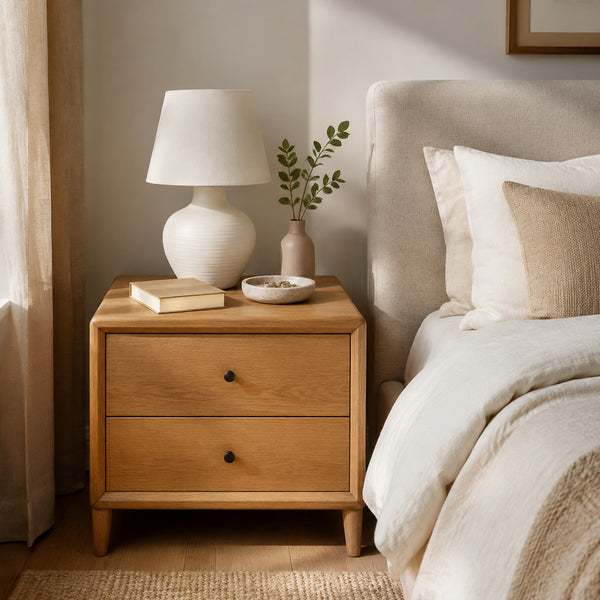
- Modern farmhouse bedroom: Warm wood, a ceramic lamp, linen textures, and a small branch.
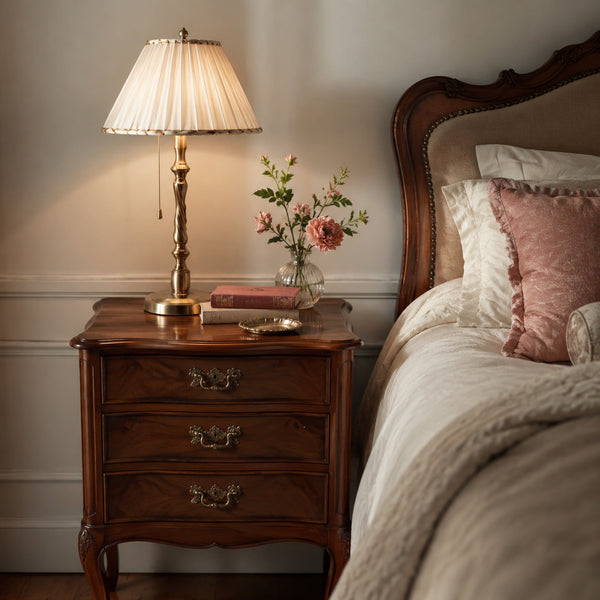
- Traditional bedroom: A pleated lamp, framed artwork, stacked books, and a brass tray.
- Contemporary bedroom: A floating table, wall-mounted light, and one geometric accessory.
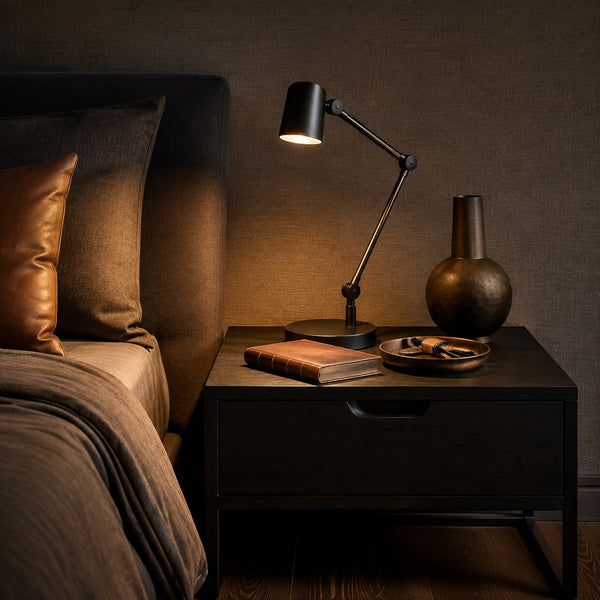
- Dark atmospheric bedroom: Black furniture, warm lighting, leather, and a restrained ceramic object.
- Coastal bedroom: Pale wood, woven textures, clear glass, and soft blue or sandy accents.
Common Bedside Table Styling Mistakes
- Covering the entire surface with decorative objects.
- Choosing a lamp that is too large for the available space.
- Leaving tangled charging cables clearly visible.
- Allowing books, glasses, and personal items to accumulate indefinitely.
- Using only objects of the same height.
- Placing decoration where it obstructs access to practical essentials.
- Choosing a table that sits far below or above the mattress.
- Trying to make both sides perfectly identical when their functions differ.
A Simple Bedside Styling Formula
For an easy and reliable arrangement, begin with one source of light, add one practical container, include one or two books, and finish with one decorative or natural accent.
- Position the lamp or confirm the placement of the wall light.
- Add a small tray for personal objects and charging devices.
- Place the current book beside the tray or underneath a small accent.
- Add one vase, ceramic vessel, plant, or framed picture.
- Remove anything that makes the surface difficult to use.
Final Thoughts
A well-styled bedside table should make daily routines easier while contributing to the calm character of the bedroom. The arrangement does not need many objects or expensive accessories. A suitable lamp, discreet charging solution, useful tray, carefully selected book, and one personal accent are often enough.
By prioritizing function, controlling visual clutter, and combining objects at different heights, even the smallest nightstand can feel attractive, balanced, and thoughtfully designed.